

Quality of life: what does it mean for you and your cat?
Making a decision about whether or when the time is right for euthanasia is one of the hardest things someone loving a pet will ever go through. Unlike human medicine, veterinary medicine is fortunate to be able to legally offer the option of gently ending suffering when there seems to be no hope for recovery. It is a difficult decision to make at best, and it can be nearly impossible for some pet owners. There are so many factors that play into it.
The term that is used the most in this context is “quality of life.” But what does that really mean? Are there hard and fast rules as to what constitutes good quality of life? Of course not. Quality of life means something different for every person, and for every animal.
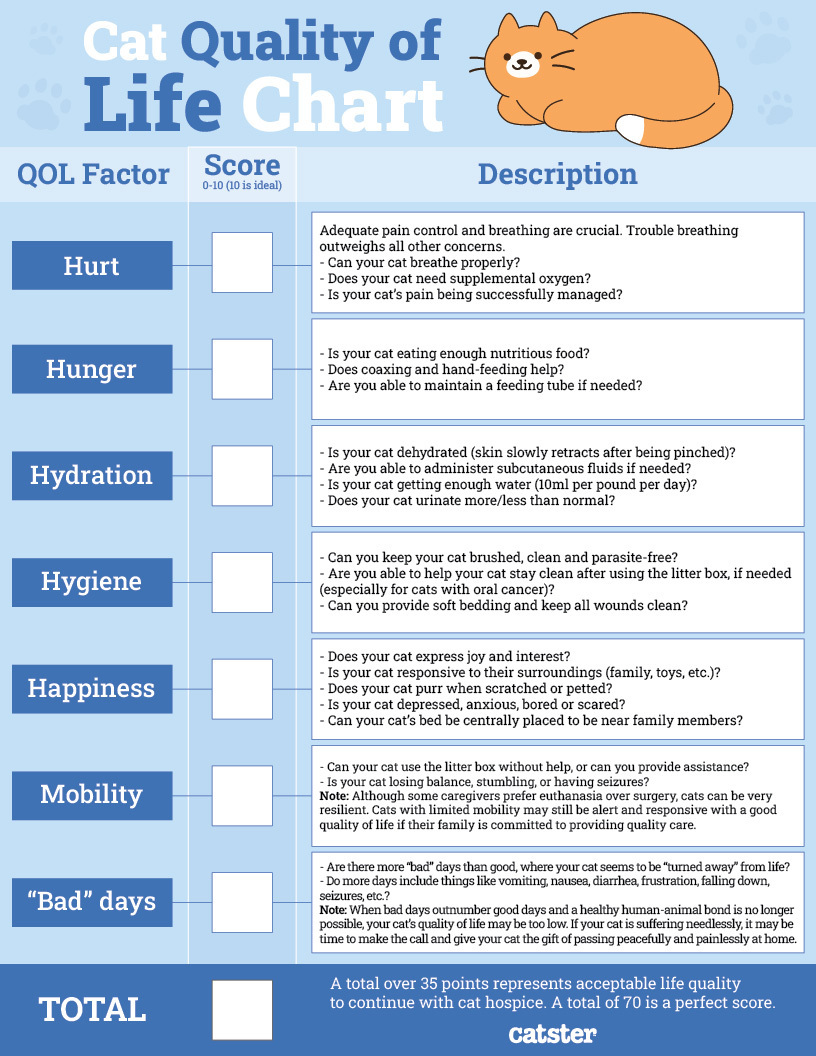
There are some fairly obvious markers. Pain is one of them. No pet owner wants to see a beloved pet suffer. Animals, especially cats, are masters at masking pain, so this can be difficult to detect. Another marker is appetite. For most pet owners, the first indication that something is wrong is usually when a pet stops eating. A third important marker is dignity. Is the pet still able to relieve herself on her own, or does she need assistance with urination and defecation?
But even these three markers are not always helpful when trying to make a decision. Pain can be managed with medication. Some pets stop eating or eat very little but are still happy and are enjoying life. And who is to say that the dog that needs assistance with being carried outside to urinate or the cat who needs help to get into the litter box and needs to be cleaned off afterwards does not appreciate this level of care from his loving human and is otherwise happy and content?
It is often said that making the decision to euthanize a pet is the final gift of love we can give our animals. I wholeheartedly believe that, but it still does not make the decision process any easier. Love and denial can be intricately linked, and it can sometimes be difficult to separate one from the other.
I’ve had to make this decision with three of my cats: with Feeebee in April of 2000, when he was losing his seven-month battle with lymphoma, with Buckley in November of 2008, when her heart disease was complicated by multiple other issues, and much too soon again with Amber in May of 2010 , after she came down to a sudden, unexpected illness, which was, most likely, virulent systemic calici virus.
All three of the decisions were agonizing for me, but I also know that each time, I made the right decision – for my cat, and for me. That’s not to say that it would have been the right decision for someone else, or for someone else’s cat.
Ultimately, the only way any of us can make this decision is by listening to our animal friends with our hearts, not with our heads. It becomes a decision of love, not something to be reasoned out on an analytical and intellectual level.
I think it’s impossible to ever be completely comfortable with the decision to end the life of someone we love so much. We do not want our pets to suffer, and when we are really in tune with our animals, we know when they are ready to make their transition. Any remaining doubt is usually caused by our sadness and grief at the thought of having to go on without their physical presence in our lives. I also believe that sometimes, our animals also love us so much that they often stick around longer than they might want to because they know how much we will miss them when they’re gone.
There is no easy answer for the question of what quality of life means. It’s going to mean something different for each person, and for each cat. And as your cat’s guardian, you’re the only one who can answer it.
Have you had to make this decision for your cat? What does quality of life mean for you and your cat?
Portions of this post are adapted from Buckley’s Story: Lessons from a Feline Master Teacher.
Related reading:
The final farewell: options after your pet dies


This is a beautiful post, Ingrid. We had a cat, Tabitha, who showed up on our back porch when I was about 14 and decided to adopt us. She quickly became my father’s cat. When he moved into a senior citizen apartment I didn’t hesitate to keep her. When I was about 29 or 30 I noticed one Saturday she didn’t look well. I watched her all weekend and made an appointment with the vet on Monday. when he told me she had acute kidney failure I was in shock. She looked fine up to that last Saturday. He told me the best thing was to put her down. I asked if there was anything we could do, I didn’t care about the cost. But he told me it was best for her, and the fairest thing for her. I was not expecting to come home without her, and when I got there my other cat was inspecting the empty carrier. The best decisions are often the most difficult ones.
Thanks, Dawn. That had to have been devastating to have to go home without Tabitha,, even knowing that you made the right decision.
I had to make this decision for my first cat. His kidneys had failed 3 months prior, and I was able to keep him alive for that additional time with subcutaneous fluids, fresh liver cooked for him so he could drink the broth, and Haagen Dazs vanilla ice cream. He wouldn’t take the pills the vet gave him; that cat was a master at spitting out pills! So I knew he was living on borrowed time. I’d asked my vet’s receptionist how I could possibly know when the time would come, and she said, “You’ll just know.” The night before, I could tell he wasn’t feeling great and had given him some fluids. I held him on my chest as I fell asleep on the couch, and when I woke up I was wet, but there was no odor to it; it was just the fluids going through him, he unable to hold them in, his kidneys unable to process them. I changed clothes and continued holding him, then woke up again when this happened a second time! In the morning, I got up and put him in my bathroom as I got dressed. There was no point in trying to hide that I’d been crying a little, although my main crying over his passing had been done a few months prior, when his kidneys had first failed. I didn’t put him in a carrier for the short drive to the vet because he hated being in them; I held him on a towel in my lap. I carried him into the vet’s in my arms, looked at the receptionist and just said, “It’s time.” She immediately went into action, getting everything prepared for us. His third eyelid was showing on the inner corner of his eyes, so I felt that he was probably in the early stages of dying, anyway. At least thinking that made me feel better about the decision. He was crouching low on the table, staying as close as possible to me. Even though he wasn’t the brightest cat I’ve ever known, I think he had a sense of what was happening, and being close to me gave him some comfort. Even though I knew it was the right thing to do, it will always bother me a little.
When I lost a cat to FIP 2 years ago, I didn’t know the seriousness of what he had, so didn’t make the decision to euthanize. He died a week later, overnight at the vet’s hospital, in a cage and alone. I’ve always felt bad about that, too. It’s never easy to lose a cat, and euthanasia is one of the toughest decisions a cat owner has to make!
Thank you for sharing your experience, Lynn. It sounds like your cat let you know without a doubt that it was time, and I’m glad you were able to comfort him until the last moment. I’m still smiling at Haagen Dazs vanilla ice cream being part of his regimen!
I’m so sorry about the cat you lost to FIP – such a horrible disease. It must have been so painful to not have been able to be with him when he died. I can understand that you still feel bad about it.
Thank you for this wonderful post, Ingrid. This is by far the best and most sensitive article I’ve ever read on this very delicate and tough subject. You have said such wonderful things, I completely agree about that being the toughest decision one could ever be faced with, and that it is always a different case and decision…
I have fortunately never had to make this decision, but I’m really so terrified at the thought. I think the “border” between an acceptable quality of life and a non-acceptable quality of life is an incredibly thin line… that’s really a tough subject. I really appreciated your mentioning that life may still be acceptable under some conditions.
I hope I will be able to understand what the “best” thing is if ever I’m faced with this terrible decision.
Thanks, Anna. Hopefully, you won’t ever have to make this decision, but if you do, from what I’ve come to know about you through your comments here, I have no doubt that you will know if you’re ever faced with this decision. Your heart will tell you.
Thank you, Ingrid. What you say is so beautiful. Really… THANK YOU.
I certainly agree that this is a very good article.
I had to go through the decision process in mid March of this year. This is a bit long, but here is what happened.
My 13 year old orange tabby, Tyger, had been showing symptoms of asthma since the previous fall. My vet prescribed Prednisone (compounded into tuna or chicken flavoured liquid and added to his wet food once a day) which seemed to be helping. In case anyone wonders, my house is a non-smoking environment.
Things iseemed normal until the morning of March 8th. When I first saw him, he was wheezing when he moved. When he was staying still, he didn’t wheeze. I was able to get a vet appointment for that afternoon. The vet gave him an injection of a stronger steriod, which seemed to help for a while. X-rays appeared to confirm that asthma was the problem.
Several days later,, I took Tyger in for another vet visit because the wheezing was not improving. X-rays were taken again, but they managed to get a better exposure this time.
The vet went over the x-rays with me and pointed out what he was seeing. The diagnosis was some type of cancer had invaded his lung or lungs. The vet advised that there was no treatment that was possible, or likely to be of help and suggested that I consider having Tyger put to sleep sooner rather than waiting. He felt that Tyger’s quality of life was already compromised and would just get worse. The vet didn’t charge me anything for that visit, which I thought was very nice of him.
I was really not expecting this. I had adopted Tyger from the Calgary Humane Society in 2001. He was 4 years old and an owner surrender. I was fully expecting him to be around for a number of years more. He still looked fine and when he wasn’t moving around, he sounded normal. Initially, this made the decision more difficult.
So, I watched him very closely for several days. It became more apparent to me that his behavior was not the same as it had been. His activity levels were quite diminished and he was sleeping or lying down much more. He was doing a lot of open-mouth breathing, especially when he moved around. He was still eating, but he was wheezing even more when doing so. I couldn’t even pet him and cuddle him as much as usual because he sounded so horribly congested when he purred. I gave him as many of his favorite treats (freeze dried chicken pieces) as he wanted, but he didn’t seem to enjoy them quite like he had done in the past.
By March 15th, it was obvious to me that delaying a decision would not help Tyger in any way. Quite a few of his normal activities were becoming more difficult for him. He certainly wasn’t able to run up and down stairs like his usual habit. He was definitely not as interested in his food as he had been.
I made the euthanasia appointment for the afternoon of the 16th. I felt so very sad. Tyger had been such a good cat in so many ways. I felt very lucky to have enjoyed his companionship for almost 9 years. I hope that he had a good life with me.
I expect to start looking for another cat or maybe 2 in a couple of months.
I’m so sorry about Tyger, Tom. Thank you for sharing your story. It sounds like he had a hard time toward the end. It takes so much love and courage to make the decision to let them go, and you clearly listened with your heart.
You’ll know when the time is right to open your heart to another cat. It’s different for everyone, and once again, you’ll “just know” when it’s the right time for you. All my best to you.
Thanks for this article.
I’m currently going through this my nine year old, ginger & white cat called Baloo, the gentlest cat I’ve ever Seen. He has been with me for 5 years now, was a hand me down when friends couldn’t take him with them when they moved.
He stopped eating and started dropping weight fast. He has shown no signs that he is in pain, picking him up forcing pills in his mouth etc.
He had dropped from 5.5kgs down to 4.3kgs. We started anti biotics, blood tests, x-rays. It was found he had a growth near his kidney and stomach. On his 2nd visit just 2 weeks later he had dropped to 3.8kgs. He hasn’t been in pain, but was slowing down not wanting to move. So we started anti inflamitaries and he picked up, started eating again (although he barely looks at his dry food anymore). He was climbing fences, doing the rounds of the neigbourhood etc.
On his next visit to the Vets (3 weeks later) his weight loss had slowed to just 0.2kgs in that time. But in the 2.5 weeks since then he’s been slowly eating less and less.
2 days ago he started getting extra loud but unable to handle more than a mouthful of food, but crying out started. Got him some raw chicken mince and he started eating again the next morning he had brought up all that he had had. And the diarrhea started all around the house.
He’s now started to get quiet again and seems confused at times, think he may have even dropped to down to 3kgs now.
Have a visit to the Vets coming up in 2 days and I think this one might be the last one.
I know that he can not go on like this. I know this is the right decision has be made, knowing it and having to make that call is 2 totally different things.
I’m so sorry you’re going through this with your boy, Jeff. You’re absolutely right, knowing that it’s the right decision doesn’t make it any easier. You’re in my thoughts.