

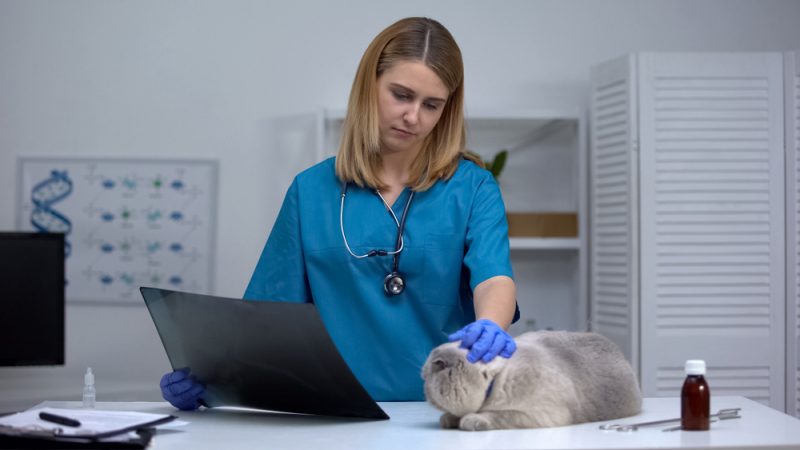
Hospice Care for Cats
As veterinary care for cats is becoming more and more sophisticated and as more cat owners understand the importance of a lifetime of preventive care, cats live longer lives. But despite all of that, cats still get sick, and when they do, there are often numerous treatment options. However, some illnesses are considered terminal, and in the past, euthanasia was often the only option pet owners would consider at that stage. An alternative to premature euthanasia that is garnering more attention in the world of pet care is hospice care.
The definition of a terminal illness is an illness for which there is no cure. It is an active, progressive, irreversible illness with a fatal prognosis. Hospice care provides a loving alternative to prolongued suffering and is designed to give supportive care to cats in the final phase of a terminal illness. The goal is to keep the cat comfortable and free of pain, with a focus on quality of life and living each day as fully as possible.
The decision to stop treatment and begin hospice care can be made at any point in the progression of a terminal illness. Decisions may range from choosing to forego aggressive surgery after receiving a cancer diagnosis because of a poor prognosis, discontinuing chemotherapy or radiation because the cat is either not responding or is dealing with side-effects that are rapidly diminishing his quality of life, or discontinuing medications because medicating the cat is difficult or impossible for the cat owner. Rather than opting for euthanasia, cat owners may choose to provide hospice care for their cat.
Hospice care is not a last resort, and is not about giving up, or about dying. It’s about finding ways to live with a terminal illness, and it may actually involve providing more care and not less. The decision to provide hospice care should be made in conjunction with your veterinarian, who will become an integral partner in the process.
Hospice care involves the following:
- Comfort: Provide clean, soft bedding with easy access to food, litter boxes, favorite sleeping spots and interaction with family members. Handle cats gently because many terminal medical conditions create discomfort and pain.
- Nutrition and Hydration: Provide easy access to food and water. You may need to experiment with special foods to tempt ill cats. In addition to feeding a high quality, grain-free canned or raw (if you cat is immunocompromised, raw food is not recommended) diet, you may need to offer foods such as meat-based baby food (make sure that there is no onion powder in the brand you buy), tuna juice or flakes of tuna spread on top of the cat’s regular food, and slightly warming the food to increase palatability. Make sure the cat always has fresh water available.
- Cleanliness: Sick cats may not be able to groom themselves. Assist your cat with this by gently brushing, and keeping eyes, ears, the area around the mouth and around the rectum and genetalia clean if she can’t do it by herself anymore.
- Pain Management: Cats are good at hiding pain. Watch your cat for signs of pain – subtle signs may involve hiding, avoiding contact with family members, or changes in sleeping positions. Rarely will cats vocalize when they’re in pain. Work with your veterinarian to develop an appropriate pain control program for your cat.
- Holistic Therapies: There are many non-invasive, gentle holistic therapies that can provide relief to terminally ill cats. Energy therapies such as Reiki, Healing Touch, Tellington Touch and others are particularly effective.
Despite the logistic and emotional challenges hospice care presents for cats and their humans, it can also be a time of great peace and increased bonding with your beloved feline companion. It also allows for a gentle preparation for the impending loss for both cat and human. Diagnosis of a terminal illness does not have to be the end – it can be the beginning of a deepening, peaceful, final phase of life for both cat and human.


Those are great facts about Hospice care for your sick cat. I have done this many times in my home but just never put a name on it. It can be a very bonding time to take care of an old or sick cat. The cats become your best friend and it does prepare you for the loss of your animal. But the fact that you have made the cat more comfortable during it’s illness is a wonderful thing.
While I was still working at the Colorado State University Veterinary teaching hospital, the Argus Institute there was responsible for starting a hospice program. They are still running strong with vet student volunteers spear-heading the program. It’s a wonderful service and one that I would certainly consider using if I needed that support!
Marg, I think the increased bond that happens during end-of-life care is one of the things that makes it such a wonderful alternative.
Tammy, I remember reading about the Argus Institute’s hospice program when I still ran a veterinary hospital. I’m glad to hear it’s still going strong.
I just happened to find out about pet hospice today and was especially interested in cat hospice. Don’t know why this subject never came up before because it truly is a blessing for pets and for their human companions. I would very much be interested in sponsoring something like this. Whoever thought of doing this truly has earned their angel wings. God bless you.
I think hospice for pets, and cats in particular, is gradually becoming more widely known. I believe the American Association of Feline Practitioners recently published a position paper on the topic. I also think that many cat owners have been doing this for a long time, but just didn’t put a hospice label on it. Hopefully, now that more people are becoming aware of it as an option, those who are caring for terminally ill cats will receive more support.
I am interested in more information on at-home hospice care. Our cat was just diagnosed with aggressive cancer. Becasue of her age, we are looking at alternatives to simply artifically prolonging her life through multiple painful surgeries. I used to work at a people hospice and wondered if such a thing was possible for our cat.
I am glad to see that I am not the only one and delighted there are so many experts who have gone this route. I have many, many questions. For example, what things do I need to talk with my vet about and what things should I be listening for?
How do I determine my cat’s level of pain and what should I look for to distingush pain from too much medication? (We’re not interested in a zombified cat, just a comfortable one.)
Can she have cat nip while on medication? She loves this stuff.
Finally, we are looking into offering a Kitty Memorial fund in place of what we would have spent on multiple surgeries. How do I dertermine the best way to donate these funds?
Guidance is appriciated.
I’m sorry about your cat’s diagnosis, Kerri. I think hospice care can be one of the most rewarding times we spend with our cats if we allow ourlvselves to go through the experience consciously, and it sounds like you’re doing exactly that.
I think it’s helpful to talk to your vet about what to expect as far as the typical progression of your cat’s particular cancer. What kinds of things can you expect physically? What is a normal part of the disease, and what constitutes a true emergency? Find out whether there are any medications you should have on hand. Can you call your vet during business hour with questions and concerns? Who should you call after hours?
Pain management is one of the most important aspects of hospice care. None of us want our cats to be in pain. Unfortunately, cats are masters at hiding pain, so pain in cats can be very hard to assess. You may find some helpful information in this article by Dr. Lorie Huston: http://consciouscat.net/2010/12/06/pain-management-for-cats/
I’ve never heard of catnip interfering with any medications, but it might be a good question to ask your vet! I’m thinking if your cat loves it, let her have it! This time is all about making your cat as happy as you can, given what she’s dealing with.
I think a kitty memorial fund is a wonderful idea. There are a lot of different charities that might be appropriate. The Animal Cancer Foundation is one that immediately comes to mind. If your cat came from a private shelter or rescue group, making a donation in her honor to them is a lovely way to celebrate your cat’s life.
I hope this helps. I’m wishing you all the best as you take this journey with your cat.
Can anyone tell me where to find hospice care for a cat in or near New York City? I am asking on behalf of an elderly woman who is now too ill herself to care for her beloved cat who is dying of cancer. Please respond to lliebman@jarvie.org. Many thanks!
[...] Hospice care for cats [...]
I am a hospice nurse for humans, which the same principles apply for pets. The purpose is comfort, both for the patient, and the family.
My nursing experience has helped me in situations with my own pets. I had a 15 yr old GS-x, who had chronic dermatitis and lowered immunity. I thought she was ready to go three years ago, but my wonderful vet suggested increasing prednisone. She lasted until this past March.
I could see a decline the last few months, but I knew she would let me know. One day I got home, and she was lying in stool and urine, crying.
That day, I took her in a beautiful basket with lots of thick padding to the vet, and held her while he administered the euthanasia.
Never for one moment have I regretted waiting, nor knowing the right time. She had it her way.
I put some of her ashes in the Gulf of Mexico, where much of her youth was spent, and she loved being there. One last trip there last Christmas was well spent.
RIP, my sweet beautiful Enya.
That’s wonderful that you were able to give Enya so much additional time via hospice care, and to let her determine when it was time to leave. You sound very much at peace with everything, which is a real gift.
Thank you, Ingrid, for your kind words. I am blessed beyond imagination.
clara
My cat was just diagnosed with cancer with probable metastasis. I have chosen to take her home on pain medication. My vet wanted me to give her subcutaneous fluids at home, but I refused. My vet was not happy with my decision.
I have worked with “humans” on hospice. Dehydration is a peaceful way to die. With the electrolyte imbalance, they go into a euphoric state. Is this the same with cats?
Thank you Clara and Ingrid for your support
Sharon, I’m sorry about your cat. I don’t think there are significant differences in cats physiologically when it comes to the effects of dehydration. I know it’s a controversial topic in human end of life care.
Giving a sick cat subcutaneous fluids can contribute considerably to helping them feel better. Depending on how ill you cat is at this stage, it may be a viable option if your cat easily accepts the procedure.
The big difference between cats and humans with this is that with cats, we do have the option to choose euthanasia, rather than waiting for dehydration to get to the point where it leads to death. It’s a very difficult decision, and one only you can make. There are a lot of factors that will come into play with this decision, from your own personal belief system to your cat’s temperament. You know your cat better than anyone else, and you will know if and when she is ready to let go.
My heart goes out to you – this is such a difficult time, but it can also be a time of an even stronger connection between the two of you. Treasure every moment you have with your cat.
Ingrid, I can’t thank you enough for your support. Everything you said is what I needed to hear. This is a new experience for me. I raise chickens and have a “mind-set” when they die, but this sure is different.
My cat, Sika, has not eaten or drank essentially anything for the last few days. She also has not had a stool or urinated. She does not seem to be in any distress and will still purr occasionally. A hard question to ask and answer, but do you know how much longer she has to live?
Thank you again for your support.
It sounds like Sitka’s body is starting to shut down, but based on what you’re sharing, it sounds like she’s comfortable. It takes courage to do what you’re doing: allowing the dying process to unfold naturally. I couldn’t even begin to tell you how much longer. You’re in my thoughts.
I am in a hospice situation right now with one of my cats and I have a question. He has HCM that has progressed to the stage of congestive heart failure. I want to be able to let him go gently and at home, but the potential for a cardiac “crash” or a blood clot are great. We live a long way from veterinary care (45 minute drive) so there is the possibility that he could suffer greatly if either of these things happen.
I am looking into at home euthanasia but struggle to know “when”. Do you have any suggestions for this type of situation?
My heart goes out to you, Kathy. Buckley had restrictive cardiomyopathy, and I, too, feared the possiblity of a clot. I eventually had to make the euthanasia decision for her for other reasons. I cover her specific story in more detail in my book, but here’s a post I wrote about making the euthanasia decision: http://consciouscat.net/2011/08/22/euthanasia-the-loneliest-decision/ I hope it’ll help you.
This is one of the websites I consulted in the last few days. Thank you for the information. My sweet 21 year old tabby girl Alexis took her last breaths as she lay on my chest last night. I am glad there is information about hospice care for pets- It totally fit my desires. Although I had never lost a pet before, I knew when she would die within 24 hrs of when she did… she made some quick cries that she had not made before, and she couldn’t walk on her own any more. Remember that your pet will probably urinate or deficate when it dies, and my experience is that the last breaths were not peaceful… she gasped deeply 3 times. It has been less than 24 hours and I think I feel more at peace than I would have if I had her euthanized.
I’m so sorry about your Alexis, Emily, but I’m glad she was with you when she died and that you feel at peace. A vet once told me that when cats take those final, agonal gasps, they’ve already lost consciousness.