
Conscious Cat

March 26, 2012 19 Comments

Feline hepatic lipidosis – fatty liver disease in cats

Posted by Ingrid

yellow cat

Hepatic lipidosis, more commonly known as fatty liver disesae, is the most fequently seen forms of severe liver disease in cats. The liver has many complex functions, including the production of chemicals necessary for digestion and the detoxification of the body. It also plays an important role in metabolism. Because of its vital importance, the body has no way of compensating when the liver fails.

Causes

While hepatic lipidosis is considered idiopathic, which means that the cause is not known, it is almost always preceded by anorexia, a cat’s nearly total avoidance of food. When a body is undernourished or starved, it starts to metabolize its own fat reserves for energy. Cat’s bodies are not able to convert large stores of fat. When a cat is in starvation mode, the fat that is released to the liver is not processed efficiently and is simply stored there, leading to a fatty and low functioning liver.

Hepatic lipidosis is usually a secondary cause of an underlying or already present condition such as obesity, diabetes, cancer, hyperthyroidism, pancreatitis, kidney disease, or another type of liver problem. Cats who are already overweight are more prone to this condition than normal weight cats.

Symptoms

  • Anorexia. A previously healthy cats stops eating. Whenever a cat goes for more than 24-48 hours without food, this is cause for concern.
  • Lethargy
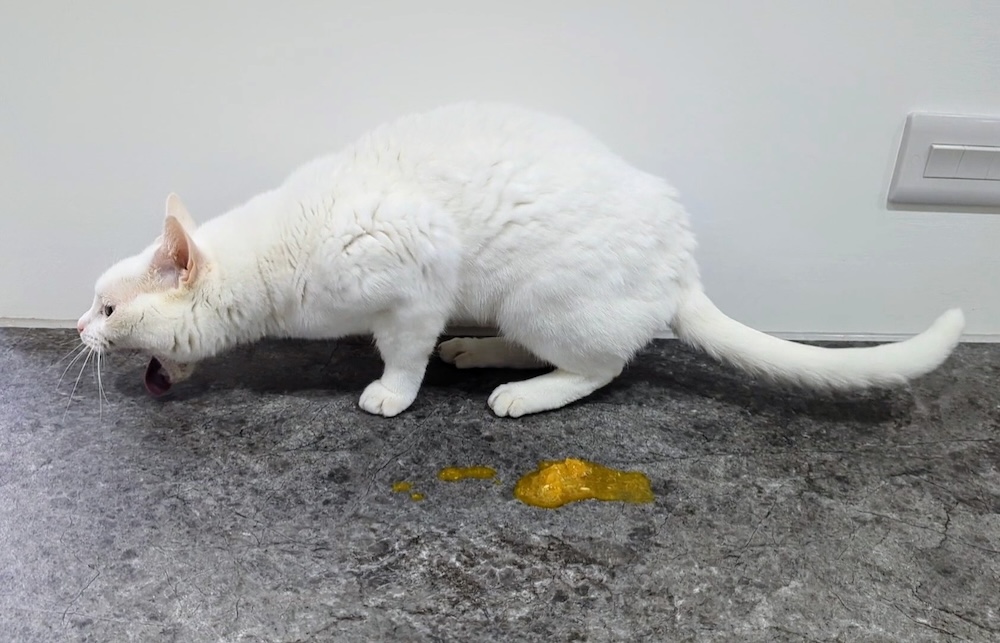
  • Vomiting and/or diarrhea
  • Depression
  • In the latter stages, yellowing of the skin, eyes, and mucuos membranes

Diagnosis

Diagnostics will include a complete blood count, blood chemistry and urinalysis. Typically, blood test will show an elevation of liver enzymes and bilirubin, and may also reveal abnormally sized red blood cells. High levels of bilirubin may also be present in the cat’s urine. X-rays and ultrasound may show an enlargement of the liver. Your vet may also want to obtain biopsies of liver tissue.

Treatment

The goal of treatment is to nourish the cat immediately by giving IV fluids, vitamins and concentrated nutrition. The cat may initially be hospitalized for a few days. While syringe feeding may be possible, in most cases, cats require a feeding tube. While many cat guardians balk at the idea of a stomach tube, it is usually a better solution than force-feeding via syrings, especially since in most cases, force feeding will need to continue for a period of 3-6 weeks, even once the cat is recovering at home. Lisa Pierson, DVM has an excellent article on Feeding Tube for Cats on her website.

At the same time, it is also critical that the underlying cause of the hepatic lipidosis is identified, so appropriate treatment can be initiated without delay.

Prognosis

If diagnosed early, and if the cat survives the first few days of aggressive treatment, the prognosis for a full recovery is excellent. If left untreated, the condition is fatal. The good news is that most cats who survive an episode of hepatic lipidosis usually don’t have a relapse.

Photo by Enid Yu, Flickr Creative Commons

Related Posts Plugin for WordPress, Blogger...
FacebookTwitterGoogle+LinkedInPinterestShare

19 Responses to “Feline hepatic lipidosis – fatty liver disease in cats”

  1. I am familiar with these disease because when we first brought home our 8-yr-old cat from a shelter, he quit eating. I knew nothing about cats at the time and simply thought he just had to have time to adjust to his new home. Other than that, he seemed perfectly fine. I bought all kinds of different food and laid out buffets for him, but he’d just sniff and walk away. I thought he was a picky eater but when I finally called the vet after about 4 weeks of this, I was told he was a very sick kitty and said we HAD to force feed him to get him to eat. The shelter took him back to their vet who nursed him back to health and we were excited to get him back. He never had the problem again!

  2. Bernadette says:

    Ingrid, how quickly does this develop? Is it over a period of days, weeks or months? A cat missing one meal is an alarm for me, but missing two meals is a call to the vet. Can this begin to be a problem after the second day?

  3. Lisa says:

    We had a cat that after a move started this . Its a very scary thing. I was told his chances were not good . Please dont give up , you can get though this. Took me close to 90 days. a New Vet did a nose tube and that did the trick after 4 weeks . Before that i was syringe feeding . Thats very hard . I feed egg yoke , boost milk repalcer , and water down recovory soft cat food. Like article said .. he was a heavy cat to start with , he was upset stopped eating . In a multi cat household sometimes , this can go un noticed a few days . He turned yellow , inside of ears and gums. Catnip , helped him get though it. He did eat catnip. I didnt want the nose tube ,.. but its not that bad . I thought how horrible , but he didnt seem to mind it and soon .. i saw hime getting better , as soon as they start to eat on own again tube can come out . Anything you offered durring the sick time , it off the menu, cats , think of the smells from whey they are sick . I gave sub fluids everyday before the tube was in place . the nose tube was not offered at the first vets .. some do not do the nose tube, as they have no been trained to do it . Dont Give Up , they can get better .

    • Ingrid says:

      I’m so glad your cat made it through, Lisa. Feeding tubes can be lifesavers with this disease. Most vets use stomach or esophageal tubes. They’re easier to manage then nasogastric tubes.

  4. It’s an ironic word combo of fatty and starvation. I can’t help but think of the poor lost cat JFK Jack who was diagnosed with this disease.

    • Bernadette says:

      Layla, that was what made me wonder how long it took to develop. He was missing for two months. How he must have suffered, and how did he survive?

    • Ingrid says:

      The term does use an odd combination of words, Layla – I never thought about that! And yes, that is one of the many things poor Jack was suffering from when he was found.

  5. Esme says:

    It breaks my heart to read this article. I thought of poor Jack.

  6. Lianimal says:

    I’m pretty sure Peaches is just picky, since shes always not really cared much for wet food, no matter what brand I tried to feed her. She’ll usually just sniff it and walk away, while the other two go to town. Once in a blue moon when she decides to eat it I have to guard her from the other two, because they are so used to eating what she leaves. I’t's wierd, because I’ve been offering it every morning since I got her at about 6 months old. We’re talking about 12 years now, She just doesn’t seem to like wet food most of the time, and I’ve tried EVERYTHING! No problem with Shanks or Monkey at all. they eat whatever I give them

  7. Sandra says:

    Just brought my 6 yr old lhd cat home from vets. She was diagnosed with hepatic lipidosis 3 days ago. She was on iv and being force fed with a syringe and a liquid. We are to continue this and try to get her to eat.

    any suggestions would be appreciated, it would do my heart good to see her get back to normal.

    Thank you

    • Ingrid says:

      I’m sorry about your kitty, Sandra. I’m glad it was caught before it was too late.

      I’m not a big fan of syringe feeding. Most cats hate it, and it tends to stress the cat at a time when she’s supposed to recover from an illness. You may want to talk to your vet about a feeding tube. Most people think that sounds terrible, but it may actually be much better for the cat than force feeding, and most cats aren’t bothered by the tube at all. Dr. Lisa Pierson has a great article on feeding tubes on her site that will give you all the details of what’s involved: http://catinfo.org/?link=feedingtubes

      In the meantime, you should, of course, make sure you kitty eats, and entice her to eat on her own. Some suggestions on how to do this: offer “stinky” canned food. Even though I don’t usually like fish flavors, in this situation, anything goes just to get a cat to eat. You can also try to sprinkle flavor enhancers over her regular food. Some things that work really well are crumbled freeze dried chicken or salmon treats, Bonita tuna flakes, or Parmesan cheese (yes, the stuff in the green can!).

      Best wishes to your kitty for a quick and complete recovery!

  8. Diane says:

    My cat was just diagnosed with acute liver failure. He had stopped eating for a few days and I became concerned. I did not realize that even a day or two without eating would be so serious. My vet has told me to feed his a watered down hepatic prescription canned cat food, milk thistle, antibiotic and vitamins. He hates the syringe feeding and I probably hate it more than he does. It has been 5 days since I started the aggressive treatment. My vet was not very optimistic about his recovery 50-50. But, I have read that if caught early the disease was very treatable. Ming was obese and over 10 years old so he fits the criteria for developing the disease. My question is when can I see signs that the treatment is working. I hate the thought that I am putting him through this and it’s not helping. He is so important to me and I hate the fact that he hides from me and the only time I am with him is when I am trying to force feed him. I would appreciate any responses. Thank you.

    • Ingrid says:

      I’m so sorry that Ming is going through this, Diane. I would talk to your vet to see whether placing a feeding tube is an option for Ming. It’s a simple procedure and cats tolerate it well. It’s so much better than force feeding. The tube stays in place until Ming starts eating on his own.

  9. Janice says:

    My Vet found a cyst on my sonny left hip and it was big she lanced it . He is a indoor cat always so we don;t know this happent it was not from a bite It started out with a fever that last a week at 1002 to 1006. The vet new there was a infection taken x/rays ,and blood wk the results there was a infection. At first he was still eating and now he in a lot of pain and he can’t even stand up with out a cry. He’s been getting IV’S for days. pain med. antibiotic plus he had a blood transfusion . I am feeding him AD can food by syringe every two hrs . Am so afraid i will lose him . I would like any responses. Thank you

Leave a Reply